Frequently Asked Questions about our stroker kits:
Here are the answers to the most frequently asked questions we get about our stroker kits. You can click on the questions below to jump down to a specific question, or scroll down the page to read everything. If you have a question that is not answered here or on the stroker kits page, please let us know.
1) How much Horsepower will my stroker
motor make?
2) Are the
kits in stock and ready to ship?
3) What kind of bearings should I run?
4) Do the kits come balanced?
5) What other modifications or machine work is necessary to run these kits on
an "RB" (413/426/440) engine?
6) What other modifications or machine work
is necessary to run these kits on a "B" (383/400) engine?
7) What will my compression be?
8) I have looked around at the competition's
kits, and yours are considerably less money. Does this mean they're lower
quality? What's the catch?
9) Great, what should I do BEFORE I order my
Stroker Kit?
10) Do I need the rod bolt upgrade?
1) How much Horsepower will my stroker motor make?
This is probably our most commonly asked question, and an accurate and correct answer depends on many different factors. As far as the horsepower level or the strength that our parts are capable of withstanding, we generally rate them very conservatively at about 1000 horsepower. Many customers and some magazine builds have made over 1400 horsepower on the dyno, and are still running many years later without failure. However, that does not automatically mean that putting together a stroker motor will instantly guarantee you 1000+ horsepower. While the old saying "There's no replacement for displacement" is as true today as when it was first said, many other factors besides cubic inches contribute to the horsepower output of an engine. An engine is basically an air pump. The more air you can pump through it, the more horsepower it's going to make. In order to take full advantage of all those new cubic inches you are adding, you have to be able to "fill" them (meaning the cylinders) up with air. The air that goes through your engine has to go through many different parts along the way. It must go in the carb, through the intake, head ports, valves, exhaust, etc, etc. Along the way, any of these parts can either help the flow or restrict it. It is a bit like a chain. A chain will only be as strong as its weakest link. Likewise, the path of airflow through your engine will only flow as much as the most restrictive part in the chain will allow it to flow. Usually, the most restrictive part (the "weakest link") in a big block Mopar engine is the cylinder heads.
So, as a given rule, the more cubic inches an engine is, the more power it will make. However, the horsepower output will largely depend on the overall combination you are using. We could take a 500" short block and with stock heads and a mild cam, it might make around 450-475 horsepower. We could then take that same shortblock, put in an .800" lift roller cam and fully ported B1 heads, and it might now make 900-1000 horsepower. With a more common and streetable setup such as using our aluminum STEALTH heads without any additional porting , along with a cam in the .540-.560" lift range, most people will end up making in the 540-580 horsepower range. With our CNC ported STEALTH heads, horsepower numbers in the high 600 to low 700 range are not uncommon. With the more serious race heads such as Indy, B1, etc, many people are making 700-800 horsepower or above. Add a supercharger or turbocharger(s) to that, and the sky's the limit (but you better make sure your block can handle it!)
2) Are the kits in stock and ready to ship?
Yes, the kits are normally kept in stock and ready to ship. At any given time, we stock over 300 stroker kits. No other shop comes close to the selection of crank strokes, rod styles and lengths, piston types and bore sizes we have available on our shelves and ready to ship immediately. Payment with Visa or Mastercard will usually get a kit out to you within a day or so. For balancing, you can usually figure on a few days to a week, depending on how many kits happen to be in line at any given time. We also stock pistons in dished, domed, and flat top configurations, and in .030", .040" and .055" and sometimes .060" over, along with rings to match most every bore size and configuration. Want to add some of the other goodies on our web site such as a timing chain, lightweight starter, SFI flexplate or damper, or high volume oil pump and deep sump pan? Chances are we have all that stuff on the shelf and ready to ship out also. Because we specialize in ONLY big block Mopars, we normally keep EVERYTHING on our web site in stock and ready to ship. It is not uncommon for customers to place an order for nearly their entire engine project of 70+ parts, and have the whole order ship out 100% complete the same day. No other parts house (not even Summit and Jegs) can compete with us on this.
3) What kind of bearings should I run?
Clevite makes 4 different types or "series" of bearings. They are the P, H, V, and M series. The M series are a very short life bearing used only for specialized applications (like top fuel), so for almost all applications the M series will not be the best choice. For almost all performance applications (when offered by Clevite), we supply Clevite's "H" series, which is their "Performance" upgraded bearings. These are used in Nascar and many different types of racing applications, but they also have a long life and work great for street performance applications. You can read more about the different series of bearings, specifics of manufacturing, etc on our Bearings page.
One other very important fact to consider when choosing bearings is that for extra strength, our cranks have a larger than stock .125" radius on the edges of the journals. The P series are designed mostly as a stock replacement bearing to work primarily with stock cranks so they do not have any clearance cut into them for this larger radius. The H and V series are performance bearings are intended to be used with new aftermarket type racing/performance crankshafts, so they are already clearanced for the larger radius. When using the P series bearings with our crankshafts, they may have to be champhered to avoid hitting the radius, whereas the H and V series will generally not have this problem. This is why we offer the H and V series bearings as standard in our kits. The only exception is for the low deck ("B" series engine) main bearings, where the only series offered by Clevite is the "P" series. In this case, we champher them ourselves on CNC lathes and offer this as an optional upgrade. Remember, bearings are not like rocker arms, intakes or even heads where it is relatively easy to change them later on. The engine gets balanced with the bearings, and once they are in, it requires tearing the engine completely down to change them, so it pays to spend a little extra in this category and buy the best you can afford. That being said, selection of parts when building an engine is based heavily on opinion, and every engine builder and/or machine shop has their own preference for what they like to use, so be sure to collaborate with them before ordering. Opened bearings are non-returnable.
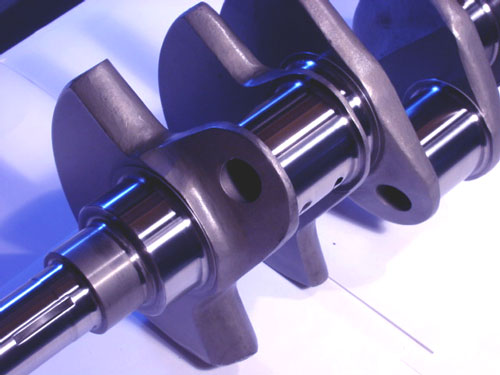
Yes! We may have the world's only balance machine that has never been used to balance any engine except the Big Block Mopar! Balancing nothing but Big Block Mopar stroker cranks all day long, everyday allows us to develop a level of familiarity and skill with this setup that no other shop can even come close to offering. The end result is a super clean, super accurate balance job done on cutting edge machinery by techs who know the process like the back of their hand in a clean & efficient work area at a VERY fair cost. No other warehouse store, (or especially a local machine shop) can compare. See our BALANCING page for details. When understanding the concept of balancing an engine, it is helpful to think of the crankshaft as being "split" lengthwise into two halfs. One "half" would be the counterweight side of the crank, and the other half would be the side with the rods and pistons. When you balance an engine (or crankshaft) essentially what you are doing is making the counterweight side of the crank equal the rod and piston side. If the counterweight side of the crank starts out too heavy, all you have to do is remove metal from the counterweights and lighten up the crank, or bring it "down" to where it needs to be to equal the rod/piston side. This is a standard, inexpensive balance job that most any machine shop (including us) can do. A problem can come up when the counterweight side of the crank is too light, and requires adding metal to it, in order to get it UP to the weight of the rod/piston side. You may have heard of this as adding "heavy" metal or "mallory" metal to the crank. This is a very expensive procedure in terms of both labor and materials. Because the rods and pistons in our stroker kits are so light (our rods alone are about 100 grams per rod lighter than the competition -- multiplied by 8, that's 800 grams, or more than the weight of an entire piston AND pin!!) most of our kits will have bobweights in the 2050-2300 range, far below the bobweight the cranks come pre balanced at, meaning there should never have to be any material or metal added under any circumstances, just removed.
5) What other modifications or machine work is necessary to run these kits on an "RB" (413/426/440) engine?
For an RB engine, some very minor clearancing of the very bottom of the cylinder walls will usually be required. Sometimes you may also need to clearance the inside of the boss where the oil pickup tube screws in. Some blocks have more "meat" in them than others, so exactly how much you will need to clearance will depend on the specific block you are using. The larger the stroke, the "farther" away from the center the rods are going to be positioned, so the stroker kits with larger strokes will generally require slightly more clearancing. Most people who have enough technical skills to assemble an engine can do this clearancing in their garage with a die grinder in less than a couple hours. No actual extra "machine work" is required. Most of our smaller kits (512CI and below) usually will work with stock oil pickups, and stock oil pans. Also, don't forget you can't run the stock windage tray, a special stroker windage tray is required. We've got 'em listed on our site for a real nice price (of course..)
6) What other modifications or machine work is necessary to run these kits on a "B" (383/400) engine?
All of the above on the "RB" engines also applies to the "B" engine. This means some very minor clearancing of the very bottom of the cylinder walls and/or inside of the boss where the oil pickup tube screws in will sometimes be required. Some blocks have more "meat" in them than others, so exactly how much you will need to clearance will depend on the specific block you are using. The larger the stroke, the "farther" away from the center the rods are going to be positioned, so the stroker kits with larger strokes will generally require slightly more clearancing. Most people who have enough technical skills to assemble an engine can do this clearancing in their garage with a die grinder in less than a couple hours. No actual extra "machine work" is required. Most of our smaller kits (512CI and below) usually will work with stock oil pickups, and stock oil pans. Also, don't forget you can't run the stock windage tray, a special stroker windage tray is required. We've got 'em listed on our site for a real nice price (of course..) Our "B" engine cranks also come with the smaller factory sized counterweights, so you will never have to turn down the weights, which can be a problem with some of our competitors kits. One other issue you should be aware of is that Clevite (or any other bearing manufacturer that we know of) does not currently make a narrowed or champhered main bearing for the "B" engine, so in some cases it may be necessary to slightly narrow the main bearings if you find they are coming in contact with the radius of the crank. We offer pre-champhered main bearings (which we do ourselves on CNC lathes) as an optional upgrade on our "B" engine stroker kits. The champhering can also be easily done yourself with a tool called a "bearing knife." We carry these as part number 200-1122, available on the "Tools and Supplies" page of our web store.
7) What will my compression be?
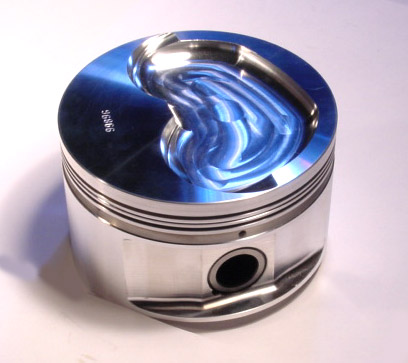
Compression depends on many factors. A big determining factor for compression is cylinder head CC size. We list a very detailed tables on our stroker kits page for each kit, and there is additional info on our pistons page that will tell you what your compression will be with all the popular big block Chrysler head CC sizes. While each kit will differ slightly, in our popular 440>>500 kit, (for example,) we offer 3 different types of pistons; domed, flat top and dished. These three different pistons are engineered to have a 2 point "spread" of compression ratio between them. In other words, with a given head CC size (take a stock 906/452 head at 88CC,) you would have 8.6 with the dish, 10.6 with the flat top, and 12.6 with the dome. So, choose the type of piston that will get you closest to where you want to be. From there, there are many different ways to "tweak" the compression up or down slightly. If you need less compression, you can run a thicker head gasket (the ratios are figured with a .039" gasket, but Fel-pro also makes a .051" - this should drop your compression by about .4 or .5 tenths of a point), and there are many other aftermarket gasket companies such as Cometic, SCE, etc which offer gaskets in many thicknesses between .020" and .120". These many thicknesses will allow you to tweak the compression to exactly where you want it. Alternatively, you can also run the pistons farther down in the cylinder (aka don't deck the block,) or polish the combustion chambers to increase the CC's slightly (this also helps to reduce detonation.) If you need more compression, you can surface the heads, run a thinner head gasket, or surface the deck of the block slightly more to run the pistons at zero deck instead of slightly below deck which is where most pistons will come in at. This alone will usually give you a few tenths of a point. So, there are many ways to play with compression. As a general guideline, it is usually easier to bring the compression up than it is to lower it, since once heads or blocks have been surfaced, there is no way to put the metal back. If there is no way to get the exact compression you need with an off the shelf piston, as a last resort, you can always order a custom piston and specify the compression exactly where you want it, along with bore size, ring pack size & location, and anything else you can think of.
8) I have looked around at the competition's kits, and yours are considerably less money. Does this mean they're lower quality? What's the catch?
There is no "catch." Our products are actually BETTER quality than the competition, AND at a much lower cost. Shop around and you will see nothing even comes close. When shopping around, compare the actual engineering specs of our products to the competitions, rather than just the cost. Remember, the parts themselves only "know" how well they are made, not how much they cost. Cost is only an artificial value someone has decided to assign to the part, based on many factors beyond just the quality of the product itself. If the company has a huge warehouse and/or retail store that stocks hundreds or thousands of different part numbers, prints a full color catalog, and does widespread and/or full color advertising, all those things cost money. That money spent must be made up for in profit, or the amount that the parts are marked up in price. Often, the final cost has more to do with the above listed factors than the quality of the parts themselves. We are a relatively small, very specialized company that focuses all our efforts on the big block Chrysler engine. We sell relatively few part numbers, and we are able to manufacture those parts in very high volume, allowing the factory production line to setup their machinery for mass production of large numbers of one specific part, bringing the cost per part down considerably. When we combine this volume discount with our philosophy of keeping our expenses low, (we do minimal advertising, use our web page in place of a color catalog, and are a mail order only company, meaning we do not have a public storefront,) and then pass all these cost savings on to the customer, we end up with much higher quality parts at a fraction of the competition's cost.
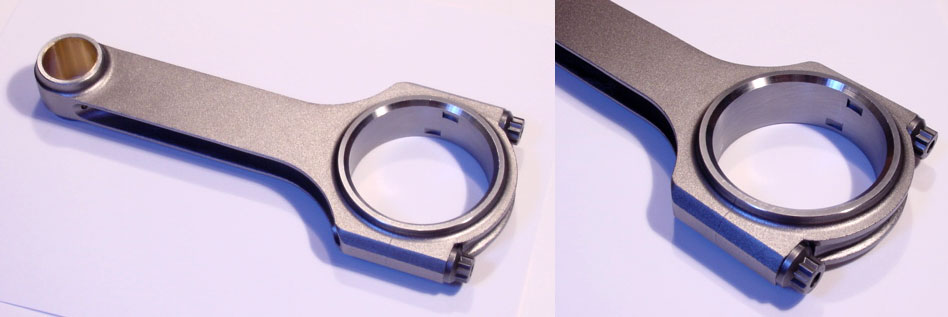
When calling around, be sure to compare specific specifications. Take our Platinum Series connecting rods for instance. We use only genuine American Made ARP bolts. Find out what type of rod bolts the competitions rods use. Several of our competitors (including most of the rods sold on EBAY) use a no name overseas bolt not even made by ARP at all. Are rod bolts a place where you want to skimp on your motor? We hope not. If you need to save some money, buy cheaper valve covers, but don't compromise critical fasteners. Once you've compared bolt strength, move on to weight.
Our Platinum Series 440 rods weigh about 740-750 grams. That's over 100 grams per rod lighter than the competition, or 800 grams when you multiply that weight savings by 8, more than the weight of an entire piston AND pin. That's some serious horsepower gain, not to mention all that weight saved puts considerably less load and abuse on the bearings, block, crank, etc. Why is our stuff so much lighter? Simple. When the larger companies (selling hundreds or thousands of different part numbers) design a raw forging, in order to save money, they will design that forging to work for multiple part numbers. For example they may design an H beam rod forging to work for every rod they offer from 6.700" - 6.900" By doing this, they can do a much bigger production run of the forgings (saving money) but the end result is a heavier piece, since more metal is required to accommodate all the different parts the forging will be made into. Since we only make and sell parts for Big Block Chrysler engines, when we design a forging, it is engineered EXACTLY for the specific part it will be made into, and there is no additional unnecessary metal added into the part. Our 6.760" H beam forgings were designed specifically for our 6.760" H beam rods, and that is all they will ever be used for. This is a more expensive way of doing things, but we feel the extra quality and weight savings gained by using this method justifies the additional cost.
But, even comparing strength AND weight doesn't tell the whole story!
There are also some other areas which might not be so obvious. Because we specialize in a small number of parts for ONLY the big block Chrysler engine, we can pay attention to many small details that the large companies we compete with who offer hundreds or thousands of part numbers will overlook. Take the big end width of a connecting rod. The competition provides their big block Chrysler rods with a big end width of anywhere between 1.003" and 1.009". On a standard journal width of 2.050", this will produce a side clearance of up to .045", nearly double the recommended clearance. Our rods are made with a big end thickness of 1.014", for a perfect side clearance of about .022." Keeping the proper side clearance avoids throwing excessive oil around the inside of the motor, which is much easier on the piston rings, and gives considerable horsepower gains due to less windage. Small details like this make the difference. We have given this example based on connecting rods, but the situation is very similar with other parts as well, such as our cranks, pistons, etc.
We always encourage people to shop around, because they almost always call us back in the end. Don't be scared or misled by the competitions sales talk. No additional machine work (such as turning the journals on our cranks, etc) is required. In terms of VALUE, (the quality you get vs. what you pay for it,) there is nothing like our stuff! When you combine details such as the above with the fact that everything we sell is GUARANTEED to be within spec (see our guarantee for details,) you will agree that NOTHING EVEN COMES CLOSE!!!
Still not sure? Many of our customers tell us that when they shop around and ask our competition about our parts, our competition will tell them what we sell is junk and that "you get what you pay for." We say, check out our Customers Rides page, which is chock full of our customers running 10's, 9's, 8's and even as fast as MID 6 second quarter miles with the same parts we supply in every stroker kit! Like we said above, don't be scared or misled by the competitions sales talk, instead ask them how you can argue with these types of quarter mile times, and these types of RESULTS!
9) Great, what should I do BEFORE I order my Stroker Kit?
The most critical piece of information you need to know before ordering a stroker kit is the bore size that your block will require in order to complete the finish honing of the cylinders. Because the components of a stroker kit are all precision balanced together, once a kit is ordered, specific parts in the kit cannot be returned or exchanged. Here's what you want to avoid. Let's say you have a standard bore block that has a scratch in one of the cylinders, and your machinist tells you he thinks it should clean up at .030" over. So, you order your kit with .030" over pistons, and it gets balanced and shipped. Then, the next week, you go to your machine shop to pick up your block, and your machinist tells you "Oh, by the way that scratch didn't quite clean up on that one cylinder, so we went .040" on the block instead." This situation can happen with a scratch, or even with normal engine wear. What feels like a "slight" ridge on the cylinder walls may be deeper than expected in one specific area. Now you have a perfectly good fully machined block, and a perfectly good stroker kit that are both completely unusable with each other.
To avoid this issue, do one of two things: Have your machinist fully measure the block, and if he can guarantee you 100% that it will clean up at a specific finished bore size, you can choose to take his word for it. However, if he's wrong, or if there's any kind of error during machining, etc, and the block doesn't finish as expected, it will be necessary to start over with a different block that will be able to finish at the size you need. This can add considerable cost.
The second, and more accurate way to do things is this: When a block is bored and honed, it is usually bored to within five thousands of the finished size, and then honed the final five thousandths. If you are going .030" over (thirty over) with your block, this means it would actually be bored to .025" (twenty five thousandths) over, and honed the final .005" (five thousandths) to thirty. This final honing process does two things. It allows you to size each cylinder exactly where you want it to set proper piston to wall clearance, and it also produces the proper cross hatch pattern on the cylinder walls that is required to hold oil, and allow the piston rings to break in properly. Due to normal manufacturing tolerances in pistons (found in ALL brand names of pistons) there can be very slight differences in diameters from one piston to another within the same set. The most accurate way to set piston to wall clearances, is to bore the block before you order the kit. After the boring process is completed, the machinist will be able to inspect the cylinder walls, and visually confirm that any blemishes or wear has been able to be removed by the boring process. If, for instance, the block was bored to .025 in preparation for an .030" final size, and there was an area with a blemish or wear that was deep enough that it was still visible at that point, then it would be necessary to try the next larger size, and then verify that size was then able to remove the issue. Once the block has a clean bore, you can be 100% confident in that specific size. Then, you can order the stroker kit. Then, once the stroker kit is in hand, your machinist can measure each specific piston to the ten thousandth of an inch, mark each piston as to which cylinder it is going into, then he can hone each cylinder to exactly the diameter it needs to be in order to run the specific clearance he is trying to achieve. Although this method is a bit more involved then just doing all the work (boring and honing) before hand, there is no other way to ensure perfect cylinder wall clearance in every cylinder. And, of course, we are talking about ten thousandths of an inch, so this method requires that the machinist does quality work, uses a torque plate, and keeps the cylinders perfectly round and free of taper. Taper is when the cylinder is hourglass shaped (larger at the top or bottom) instead of perfectly round.
Do I need the rod bolt upgrade?
Our kits come standard with the 100% USA Made ARP 8740 rod bolts, which are rated by ARP to be good up to 850 horsepower. So, for most people building a regular street/strip type of engine with either Stealth heads or Edelbrock Performer RPM's (or equivalent head in the 325CFM or less range,) the standard 8740 rod bolts should be no problem. If you are using Nitrous, a blower or turbo in your build (or want to have the option at some point in the future to add any of these,) then we would recommend upgrading to the ARP 2000 option. ARP rates their 2000 bolts at 1200 horsepower capable. If you are using a more serious cylinder head that flows over 325 CFM, (this would include Trick Flow 270's, Fully ported Victors, Indy's, B1's, etc,) then we would also recommend the upgrade as extra insurance, since you are likely to be at the 700+ horsepower range with these types of heads. The way we see it, nobody ever looked back at their engine build after it was done and said "Geez, I made the bottom end too strong, I wish I wouldn't have done that." But just remember, the limiting factor in your build is likely to be the factory engine block. With stock main caps, we have found that most builds will start to see cap walk at about the 600 horsepower level. If you upgrade your block with a main girdle and aftermarket billet caps, then you can usually make in the 750-800 horsepower range without any issues. But if you are making more than 800 horsepower with a factory block, you can start to see problems in the center of the block, in the area between the crank and the cam. There is no way to strengthen this area. So to reliably make more than 800 horsepower, you are probably looking at going to an aftermarket block. In a build like that, we would definitely do the rod bolt upgrade as well.
If you have any questions about anything mentioned in this FAQ section, feel free to give us a call and we'll help to clarify anything that is unclear to you.


All website content copyright 440 Source.
(775) 883-2590